.jpg)
Weaknesses of chartering software
- farah674
- 10 hours ago
- 4 min read
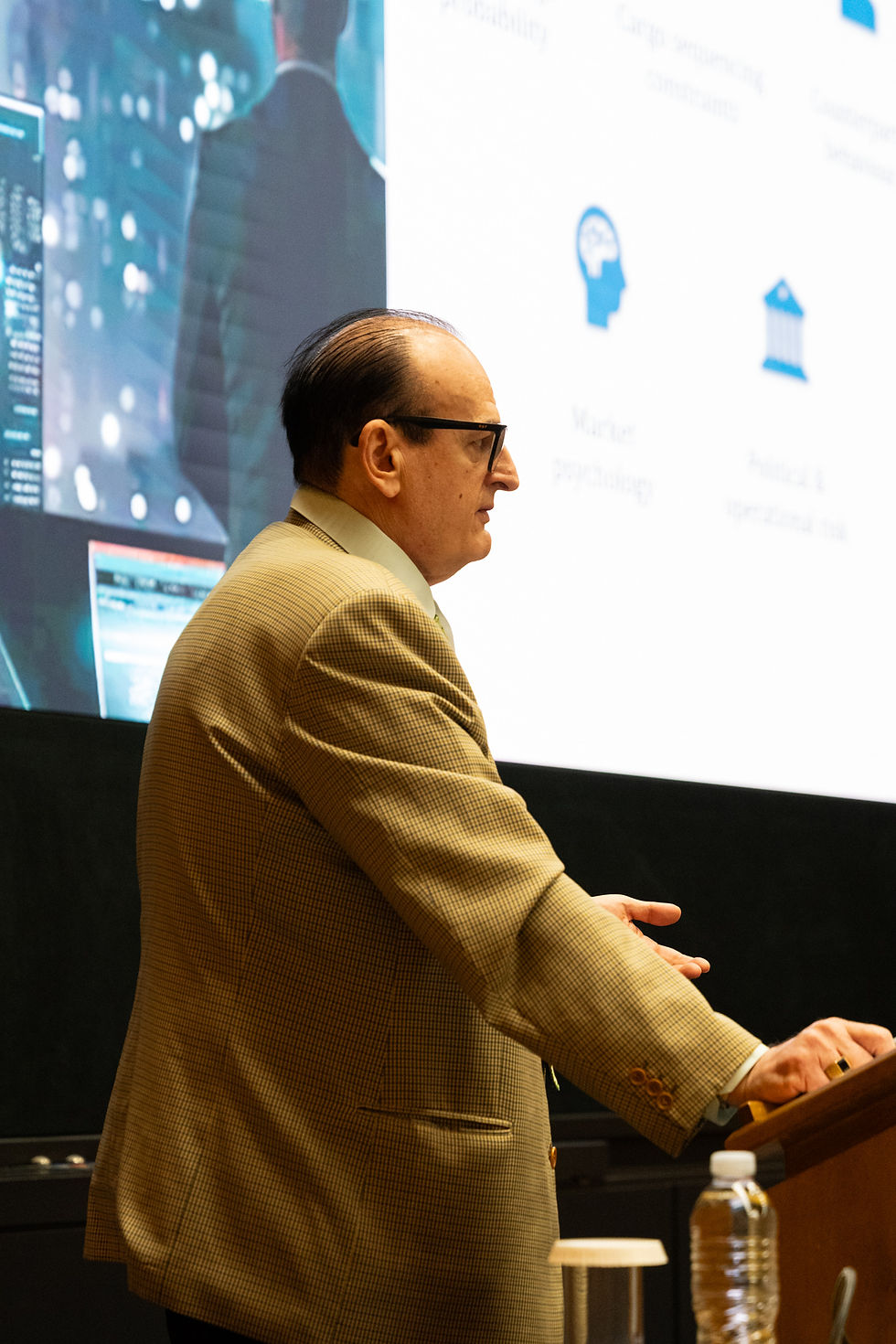
The chartering software tools demonstrated so far to Iakovos Archontakis, chartering executive of TMC Shipping seem overly complex, would take too much time, and do not fully encapsulate the challenges of chartering decision making
Iakovos (Jack) Archontakis, senior maritime strategy consultant, chartering executive and commercial director with TMC Shipping, has not been impressed with much of the chartering software demonstrated to him so far. He explained why, speaking at People Tech Maritime Athens on April 21.
Many of the tools are technically impressive and have nice colours. But they are not designed around how chartering works, how decisions are made under pressure and uncertainty,” he said.
“I'm a chartering person, not a software developer or a data scientist,” he said. “For more than four decades I have been fixing vessels in volatile markets, negotiating under pressure, managing risk and trying to make the right commercial decision, most of the time with incomplete information. “
“Chartering is not a linear process. It's dynamic, messy, fast, and constantly interrupted,” he said. “We do not operate in calm analytical environments; we operate in urgency.”
Any chartering software which involves too many steps, too much data entry or too much navigation will not be taken to warmly.
“When the market is moving, we simply won’t use it,” he said. “Speed is not a convenience. Speed is a matter of money.”
“Decisions must be made quickly with imperfect data and real commercial consequences. Charterers need to read the market quickly in order to fix the vessel with the best business.
Software which provides too much information is analogous to a TV with very high resolution, you can’t take it all in, he said. A human mind has limits to the speed it can assimilate and process incoming information.
Many factors
Chartering decisions are rarely made on data alone, he said. Other factors are timing, relationships, risk appetite, perspective of the counterparty. “A chartering decision is rarely mathematical.”
For example, they are estimating the likelihood of finding a return cargo. When fixing a Panamax cargo from Brazil to China, you assess if there may be another cargo to load in China. It would need to be a cargo which can be carried after the one you have.
And you need to assess how reliable the charterer will be. Most companies have systems for rating their clients.
Charterers have to consider possible changes in the market, possible geopolitical changes, and possible weather changes, such as in the monsoon season.
“Many of these inputs are not stored in any database. They are patterns in our mind,” he said. “It's a matter of experience and judgment formed over years. Not everything that matters is digital.”
While in theory it could be possible to bring all possible information into software, in practise it would need enormous data input, with constant updating, and co-operation from across the company in providing the data. It would need to include cargo compatibility rules, historical trade flows, and counter party scoring.
“A system that is 70% completed and fast is more valuable than a 100% complete system which is slower and needs a lot of input.”
Human brains
The human brain can beat computers in working with incomplete information, intuition, and context, he said, the situation charterers often find themselves in.
“A digital system requires structure. The human brain handles ambiguity.”
People can hold mental models of real time, complex, moving commercial situations. “At the same time as fixing a vessel, we can weigh freight, positioning, counterparty risk, future market sentiment, and fleet strategy simultaneously.. We adjust instantly when we have new information.”
Models can be built on a computer which hold the same data, but it takes much longer to build them.
What good software would look like
The ideal chartering software would “give clear relevant insights in real time, supporting decisions without replacing human judgment.” Not something with multiple layers, colours and dashboard codes.
AI can be extremely useful in some situations, such as for rapid comparison of multiple voyage scenarios. It can be used to track changes in the market and help identify historical trading patterns, he said. Traders often build tools manually to do this, so AI tools can free up their time.
It must require minimal manual input and prioritize speed and simplicity. “If it is difficult to use then you cannot persuade our colleagues to use it.”
The software designers would need to understand how chartering desks operate, perhaps from watching staff at work. “Developers have to listen to the users; they have to see their daily problems, to see how this system can assist them.”
But the chartering software should not try to replace people’s negotiation skills, relationships and instincts, because this is something which cannot be coded. It should not “try to persuade humans to think like a machine.”
“The future of maritime technology is not about replacing chartering professionals. It is about empowering them.
“The companies that will succeed in future are not those with the most sophisticated software. They are those where technology understands people, where the systems are built with commercial logic.”
“In shipping, decisions are still made by humans, and good software has to make those human stronger,” he concluded.
You can watch the talk on YouTube here https://youtu.be/TTUofOV_rrk


Comments