.jpg)
How to get better software
- farah674
- 10 hours ago
- 9 min read

IT managers from Ionic, Seaven Tankers and Newport, with Dimitris Lyras, discussed how we can get better software, including demonstrating success with KPIs, getting small successes, value from AI, and defining maturity
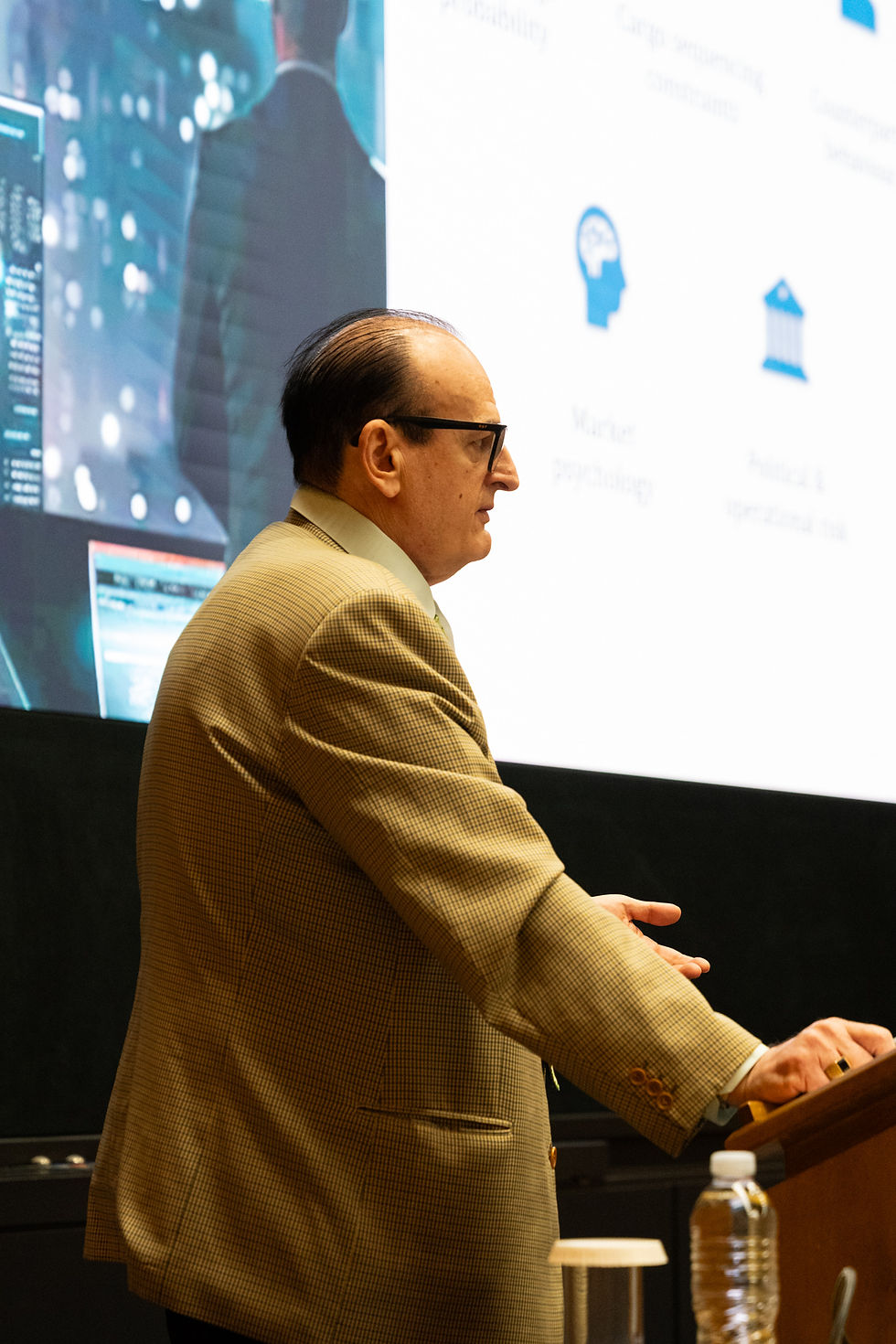
Shipowners are rarely willing to spend enough on software to cover the costs of developing software which truly helps people make better decisions, said Dimitris Lyras, director of Paralos Maritime. He was moderating a panel session of IT managers at the People Tech Maritime event in Athens on April 21.
Today’s software might help individual people do their work more efficiently, but more efficient work of individuals is not usually a shipowner’s main concern, he said.
Shipowners would appreciate software more if it could help the company avoid expensive mistakes. For example, Mr Lyras once lost a charter for one of his company’s vessels when a spare part delivery was delayed in customs.
Better software could have warned about this possible problem and advised that it would be better for an employee to take the spare part personally in their luggage, because items are rarely delayed by passenger customs in airports.
Software could also generate efficiency gains for the whole company, by helping to co-ordinate complex tasks. But shipowners do not employ “productivity managers” looking for ways to improve overall efficiency of the company, who might bring this to their attention, he said.
Meanwhile, it would help if the profile of company IT departments could be raised, so they have a role in selecting the right software, more than just fixing problems, he suggested.
“I believe [ship] owners should not be involved in the software [purchase] decision,” said Andreas Polidis, IT Advisor, Ionic.
“Owners are looking at the figures. They make investments and need to make money out of it. Owners need to trust some people to make the right [software] decision and judge the result.”
“I don't think owners should be involved in any kind of technical decisions, this is not their role. They don't have the skills or expertise to evaluate any kind of suggestion. Owners need to find the right people, have the right trust in them.”
“Maybe someone in the top level of management decides if there must be big investment in software,” said Thanos Servos, IT Manager, Seaven Tankers. “The owners, the board of the company maybe don't have enough time.”
Software KPIs
Can the performance of software in supporting company objectives be evaluated?
“If the software is good quality, and the software team has expertise, and you have enough data, software can provide many useful solutions and predictions,” said Mr Servos of Seaven Tankers. For example, it can help with maintenance or improving fuel efficiency.
“When you decide to implement software, you decide for specific reasons,” said Mr Polidis of Ionic. “You can define the Key Performance Indicators (KPIs) prior to the [software purchasing] decision and have them to evaluate whether the decision is right or wrong.”
“You want to reduce costs of the purchasing department. That's a KPI. Or you are trying to advance the technical department with a planned maintenance system. That’s a KPI.”
“KPis can be measured, it is tangible, it is something that can be achieved.”
“[But] it’s another story [about] how easy it is to set them and follow them, when changing the way a business is running. KPIs need an effort.”
“It is the only way to evaluate your decision, to set specific goals. It won't happen at once; it may take a while. You set one goal at a time then go forward. It is a matter of planning and implementing.”
“Collection of [performance] data across the fleet is not elementary,” Mr Lyras of Paralos noted. For example, with maintenance, “it is very hard to decide one overhaul is legitimate and another one isn't.”
“I agree that KPIs are the solution, but I’m not sure they are easy to arrive at.”
“There’s a lot of politics in software [purchases]. When management decides with the right experts on what software to buy, not everybody is happy. They don't all help each other to create the KPIs.”
Starting small
Shipowners may be more willing to unlock funding if you can demonstrate something which works, starting on a small scale, said Tilemachos Kreouzis, Senior ICT Officer, Newport.
“The main issue that I've been noticing [is that] people try to create a program that tries to do too much and accomplishes too little.”
This problem was also described in a previous presentation by Iakovos Archontakis, chartering executive of TMC Shipping (see separate article), he said.
“You need a minimum viable product. I don't think you can make something for everybody, that is impossible. You should find something easy to accomplish and not outsource it. Try to find something in-house that covers a need, then expand on it as time goes on.”
“Find a problem that exists in one of the operational departments. If you see it work, you add more and more things to it.”
“If you take that approach, the costs are really not that high. We are talking a couple of thousand euros to get started.”
But don’t expect your small solution to work across the company. If it is for a vessel, it will probably only work on the type of vessel it was designed for, he said.
Value from AI
There are two different types of AI used in maritime, symbolic and neuro. They don’t overlap very much if at all, said Mr Lyras of Paralos Maritime. “Their uses and implementation are different.”
“Symbolic AI has existed for 60-70 years. The Iron Dome in Israel is symbolic AI. Autonomous ships, and any automation that's quite complex is basically symbolic AI.”
Examples of neuro AI are large language models, and other tools which can find similarities in images and words.
Going forward, we are likely to see both types of AI used together. But neuro AI may be worth more focus because it is new.
The strongest use of AI could be in predictive maintenance and resolving technical problems, such as with the engine, said Mr Servos from Seaven Tankers.
We also see useful AI for route optimisation, predicting arrival time and improving fuel efficiency, he said.
AI based tools could be used firstly by the crew, secondly by office staff, and thirdly by the provider.
Algorithms are improving, leading to better recommendations. In the past, many of them were not very accurate, he said. “I think we are getting there.”
As accuracy of predictions increases, so does people’s willingness to trust them, he said.
“I think there is more room for the use of AI in the area of optimisation,” said Mr Polidis of Ionic. “This is an area with a lot of structural data, not very easy to analyse. [AI is] the only way we can manage all this data.”
“In general, AI is going to support most of the operations of the shipping industry.
“Some of the products were not so accurate,” he said. But it can be very hard to evaluate the results of AI.
“Currently we are in a phase where everybody is talking about AI. I’m not sure all the companies know how to use it or what the actual benefit will be. It’s a fashion,” he said.
“I’m not sure the shipping industry is quite ready to adapt or absorb all these new technologies.”
It is good to focus first on achievable small goals with AI, as with software implementations, he said. “We need to better understand the technology, find ways to adopt it in our organisations, and build on that.”
“We need to be very careful about the steps we are going to take. Otherwise, we invest in a new technology just for the technology rather than the benefit.”
With neuro AI, “people need to understand what it is, what it can do, what it cannot do,” said Mr Kreouzis of Newport. “People need to understand the risks involved with using these programs, what happens to the data that they input.”
Also, “shipping companies need to properly structure their data,” he said. Data in manuals, Word and Excel files, and relational databases can be hard for neuro AI to work with.
“You need to start small; you need to build something that will not have a lot of friction within the company. If something goes wrong, you're not going to have operational disruption.”
You need domain experts involved. “The IT developer is not going to be the guy to evaluate if an LLM is correct or not.”
Once a tool is working, you can roll it out slowly through the fleet, gathering feedback from crew, and improving it, he said. “Then you take the same approach and apply to a different department.”
“There's not going to be a vendor who is going to sell you a ready product for your company that is going to cover your needs for the maritime industry. You need to build something custom; you need to do it from ground up.”
“AI is great and is going to be better in the future. The models are already fantastic. What we need is better data, more structured data, and better understanding of how we can use it.”
Defining digital maturity
Individual software products can be assessed for digital maturity in terms of how much people use them, and whether it makes their working day easier, said Mr Servos of Seaven Tankers. If software is not user friendly, people will use it less.
Good software must improve how the company works and improve people’s daily life, he said. It should help manage risks and achieve the company’s goals.
“Assets can have better performance, the company will work better, the owner will be happy, the people will be happy.”
“Everyone is deeply happy to use a product that will make their life easier.”
The younger generation expect higher levels of digital maturity, he said. “They are checking their mobile phone from the first minute they wake up and it is the last thing they do in their day.”
It is very hard to assess the digital maturity of a company, said Ionic’s Mr Polidis. “I don’t think there's any scale we can reference to say this company is more mature than another.”
Maturity can be seen as in relative terms. For a company which manages activities manually, implementing ERP software would be an improvement in maturity, he said. For a company with ERP, maturity would be moving to more advanced technologies such as with AI.
Companies who think they should improve technical maturity should evaluate where they are, where they want to be and set specific goals, he suggested. They should not use technology for technology’s sake.
Another definition of digital maturity is a company willing to be the first to experiment with new technologies, said Newport’s Mr Kreouzis. Normally with IT, “nobody wants to be first, but everybody wants to be second.”
A mature organisation will have internal risk management processes, to ensure it does not over-invest in new technologies, he said.
A company grows in digital maturity from experience, just as car manufacturers improve their maturity with experience, said Mr Lyras of Paralos Maritime.
Good technology should be focussed on the organisational goal, such as helping negotiate a charter party, not asking someone to key in yet more information, he said.
Adding broader value
Technologies can add value to maritime operations in broader ways which are not immediately obvious, said Newport’s Mr Kreouzis. For example, if you provide seafarers with better internet access, your company is more attractive as a place to work.
ERP systems can make some tasks easier. “If you don't use it, you are missing out.”
Technology can provide data to support fast decision making in chartering.
Companies should make effort to improve their understanding of new technologies, their benefits, and risks, he said. “’IT’ is no longer just about information technology, it includes innovation.”
Exposing data to LLMs
Is it safe to expose company data in prompts to public large language models?
Ultimately, it is a risk decision, and should be made by senior management, informed by the IT staff, Newport’s Mr Kreouzis said. Then company employees should follow the decision.
Manuals used by shipping companies do not contain proprietary data and are similar to manuals used by other companies. Companies should not worry too much about sharing a company manual with a LLM.
Where you are concerned about sharing data, you don’t need to use the public models. Instead, you can build a local model, such as with Google’s Gemma 4, which has open-source code. It can do basic tasks running on a smart phone. These are “fantastic at this point in time,” he said. It will cost around Euro 4,000 to build.
There are also risks of data being exposed if you send e-mails on Office365 or use cloud-based ERP software, noted Ionic’s Mr Polidis. “You don't know what the provider is doing with the data.”
“But this is not a reason not to move forward and take advantage of new technologies and solutions. It’s probably a risk we should take to stay competitive and grow our business,” he said.
You can watch the discussion on YouTube at https://youtu.be/FNckDEdfw38


Comments